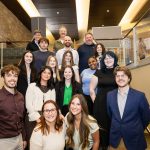
Columbia College forensic science students had a unique opportunity to gain powerful insight into their future careers during the Fall 2025 Semester as members of the Missouri State Highway Patrol (MSHP) visited main campus.
For many students, it was their first time seeing the tools, tests and decision-making processes they have studied in class brought to life by the professionals who rely on them every day.
During their November visit, MSHP Troop F officers led a series of live demonstrations that transformed abstract concepts into vivid, hands-on learning moments. Students watched as officers conducted field sobriety tests, demonstrated the use of both hand-held and evidential breathalyzers, and introduced an experimental saliva-based drug detection instrument. These real-time demonstrations revealed not only how the devices work, but also how officers apply scientific principles with precision in high-stakes situations.
Dr. Ellen M. Mwenesongole, Associate Professor and Forensic Science Program Coordinator, emphasized the importance of these encounters in tying coursework to professional practice.
“Having MSHP on campus gives students a clear picture of how science and policing work together,” Mwenesongole said. “Seeing the instruments and methods used in the field makes it easier to connect classroom lessons to real-world applications.”

For Whitney Shinn, a student in the Forensic Chemistry class, the experience deepened her appreciation for the accuracy and standards required in toxicological testing.
“The visit with Troop F allowed for more insight into the process of determining whether an individual is under the influence and the steps taken to get toxicological evidence to support a believed impaired state,” Shinn said.
In early December, the learning experience came full circle as the Forensic Chemistry class traveled to Jefferson City for a field trip to the MSHP Crime Laboratory. There, students observed the other side of the investigative process: the highly technical laboratory work that supports criminal cases statewide. From the initial evidence submission to its analysis across specialized units — such as Trace Evidence, Firearms, DNA and Toxicology — students discovered how collaboration between laboratory scientists and patrol officers is essential for building cases that hold up under courtroom scrutiny.
Together, the campus visit and crime lab field trip demonstrated that accuracy, ethics and teamwork are as essential as technical skills in both forensic science and law enforcement. By witnessing these elements in action, students gained a clearer vision of how their future careers can contribute to public safety and justice, and how science and service go hand in hand.
“Columbia College would like to thank Capt. Brandon White, Sgt. Marylyn Dickens and Corp. Olivia Imhoff from MSHP Troop F, and Katie Corcoran from the MSHP Crime Lab in Jefferson City for their collaboration and support,” Mwenesongole said. “These visits bridged the gap between academic study and professional application, enriching the students’ understanding of forensic science.”